
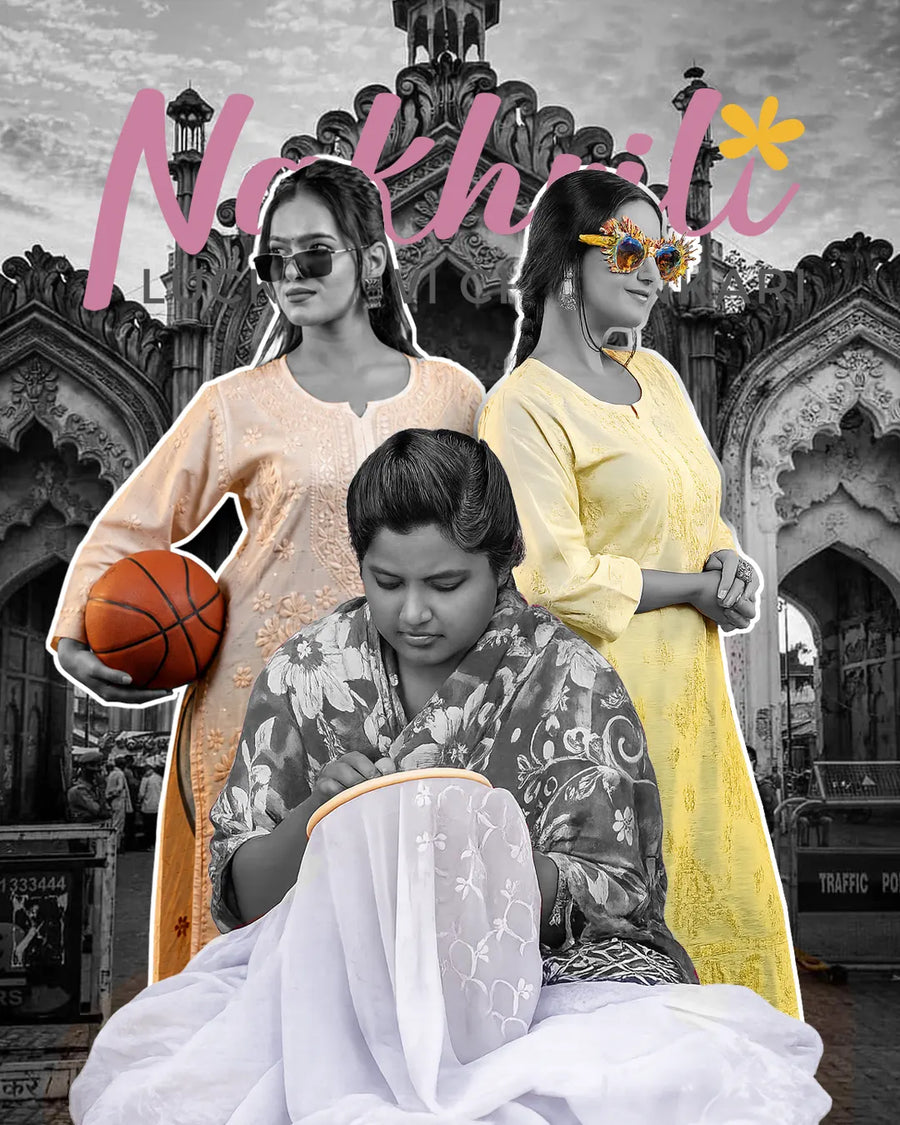
Honestly? We just wanted chikankari that kept up with us.
Our Story

Honestly? We just wanted chikankari that kept up with us.

Chikankari has always been beautiful.

We just thought, what if it was also a little nakhrili about it?

Nakhrili Chikankari is what happens when an art form stops being a relic and starts being a personality - yours.

Same craft. Same hands. Same centuries-old embroidery.

But now showing up to brunch, to college, to your 9-to-5, unapologetically, and always dressed better than everyone else in the room.

We're not reinventing the tradition. We're just finally letting it have a little fun.

Because good taste never goes out of style, it just gets an upgrade.

Our Collection
The People Behind the Thread

Meet the Artisans

Each garment tells the story of a karigar whose hands have mastered the art over decades.

Begum Fatima
35+ yrs
Jali & Phanda

Begum Fatima

location_on Chowk, Lucknow

Fatima began learning Chikankari at age nine from her grandmother. Today she is one of Lucknow's most sought-after Jali specialists, whose delicate shadow-work takes up to 40 hours per garment.

“Chikankari meri rooh hai — Chikankari is my soul.”
Salma Khatoon
20+ yrs
Murri & Tepchi

Salma Khatoon

location_on Aminabad, Lucknow

A mother of four, Salma uses her earnings to educate her children. Her Murri knots are so fine they can only be seen under magnification, a skill that took over a decade to perfect.

“Har taaga ek nayi umeed hai — Every thread is a new hope.”
Rukhsana Bano
28+ yrs
Bakhiya & Zanzeera

Rukhsana Bano

location_on Nakhas, Lucknow

Rukhsana inherited her craft from three generations of embroiderers. Her floral Bakhiya shadow-work is inspired by Mughal garden motifs still found in Lucknow's historic monuments.

“Phool banana ek ibadat hai — Creating flowers is an act of devotion.”
From Thread to Treasure

The Crafting Process

Every Nakhrili garment passes through four meticulous stages before it reaches you.

01

Design

Master designers sketch intricate motifs inspired by Mughal garden patterns and Nawabi court art.

arrow_forward
02

Embroidery

Skilled karigars hand-embroider each motif using one of 36 traditional Chikankari stitches.

arrow_forward
03

Finishing

The fabric is washed, starched, and hand-finished to bring out the full beauty of the lacework.

arrow_forward
04

Quality Check

Every stitch is inspected by our senior karigar before the piece receives the Nakhrili seal.
36 Stitches. Zero Shortcuts.
The Craft

36 Stitches. Zero Shortcuts.


Anyone can put a flower on fabric and call it chikankari.
We don't do that here.


Every piece at Nakhrili goes through hands that have spent years learning just one stitch, out of 36. Each motif is hand-embroidered, each thread placed with intention, each kurta finished only when it's actually finished.
It takes time. More than you'd expect. More than fast fashion would ever allow.
But that's exactly the point.
You're not buying something that was made in a hurry to look good in a photo. You're buying something made to outlast every trend, while somehow, staying ahead of all of them.


That's the Nakhrili difference.

Discover the Craft
Our Impact in Numbers

A Growing Community of Craft Lovers

favorite
2000+
Happy Customers
Across 40+ countries
diversity_3
35+
Artisan Partners
Empowered women karigars
style
60+
Handcrafted Designs
New styles every season
public
6+
Countries Reached
Worldwide shipping